Introduction
As part of the commemoration of the 10th Anniversary of the Referendum on EU Membership on 23rd June 2026, some of the British in Austria team of volunteers have been sharing their personal experiences.
This post describes the personal experience of Michael (Mike) Bailey, a British born, naturalised Austrian citizen living in Vienna with his naturalised Austrian (previously Russian citizen) wife and their three children.
Tell us a bit about yourself
I was born in Somerset in 1977 and after school in Taunton, I studied Modern Languages in St Andrews culminating in a degree in French and German. My Year Abroad in Styria (Judenburg) and Brussels opened my eyes. The lure of travelling and working in Europe meant that, other than to finish my degree, I never lived in the UK again.
After graduation, a job for a telecom company in Brussels fell through, so I arrived in Vienna in July 2000, to see if I could make a go of it. I worked as a freelance translator for 14 years, as well as working for an economics and finance thinktank organising conferences and publications. In 2014, I became the Austrian Financial Market AuthorityAustrian Financial Market Authority The Austrian Financial Market Authority is Austria's financial market supervisor for banks, insurance and pension companies, and investment firms. It also has a collective consumer protection remit - which focuses on ensuring that consumers as a whole are protected, but not acting on individual cases - as a consumer, you should always contact the bank, insurer etc. directly in the first instance.’s first in-house translator.
Where were you when the vote was announced and were you surprised at the result?
As the referendum was announced in February 2016, my wife and I were awaiting the arrival of our first child, and the results of the referendum were delivered on my 39th birthday, with my son just over three months old. From the blog I wrote throughout, as someone who had fallen foul of the “fifteen year rule”, I remember being nervous that it was going to be too close to call. I had done some radio and press interviews with Austrian media during the run-up to the referendum.
I remember visiting London to go to the European Banking Authority (now relocated to Paris) just before the referendum and having a sinking feeling. My main memories of results day, other than it being my birthday, were of taking my newborn son into my office on a day off to meet my colleagues and then a very funereal atmosphere at the barbecue we hosted. I was expecting it to be close one way or the other. A lot of the result was down to a failure to communicate how the EU really works and also down to politicians using the referendum for their own opportunistic ends.
How did the outcome of the referendum impact you?
I knew that I was particularly vulnerable as a third country national3rd country nationals Third country nationals are citizens of non-EU/EEA countries. Residency and naturalisation procedures for third country nationals are more complicated than for citizens of EU Member States or EEA signatory states. in the event of “no deal” given potential issues about whether I would still be able to hold a permanent contract as a third country national. I actively chose to naturalise early to avoid any issues down the line that no longer being an EU citizen might cause as I work in a politically charged environment (my logic was also about being at the front of the queue, rather than joining a long and snaking queue).
I felt less comfortable going over to the UK, including not visiting for over five years between 2017 and 2022 without visiting the UK. This meant organising my 40th birthday in Italy with my family to avoid the reminders about the anniversary of the referendum result. Having been abused for speaking German on the phone in Bristol just after the referendum certainly didn’t encourage me to want to visit.
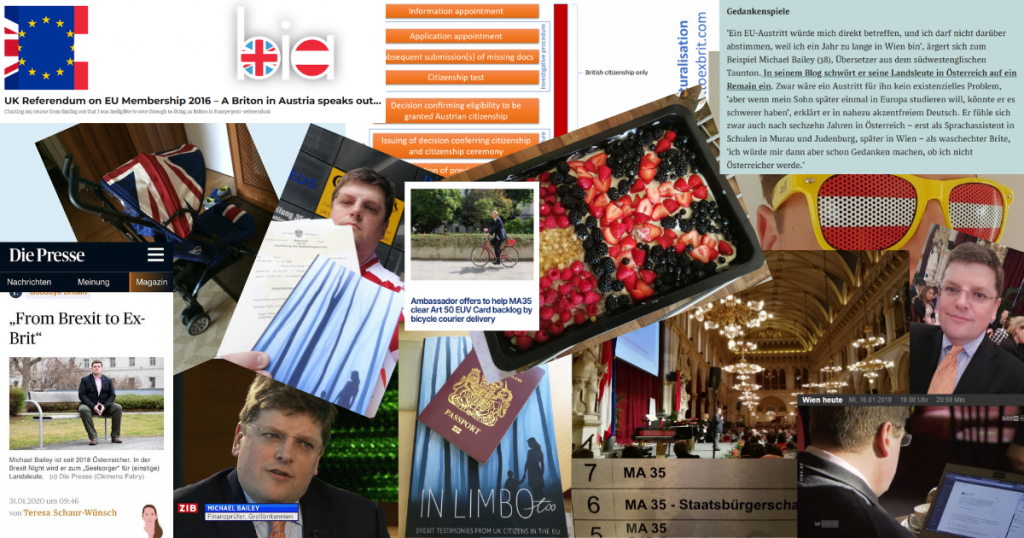
I started the naturalisation process in 2017, and became Austrian and renounce my British citizenship in July 2018, a couple of months prior to the arrival of our twins. My timing was serendipitous – my wife was stateless under her own naturalisation case when the twins were born. Naturalisation took away a lot of uncertainty and was right for me. The then Ambassador felt I was too hasty in my decision, but was unaware of the intricacies of my personal situation amid proposals for reform in financial market supervision.
Collecting my renunciation from a down at heel parcel shop felt suitably anticlimactic. I still have fond memories of celebrating my naturalisation at a reception at the Rathaus in 2019 with my family. Some people have asked why I’ve continued to help post-naturalisation – for me, part of it was my way to deal with “the new normal” and I felt it better to share knowledge and experiences than sit on it. I’ve got good friends who still feel very angry about the result – naturalisation helped my own wellbeing and gave me the headspace to focus on challenges.
What are some of the highlights related to your BiAthe Facebook groups Britishinaustria.net draws upon its two Facebook groups as a source of questions to address in FAQs or to refer to the authorities or to request clarification from government ministries or HM British Embassy. These groups can be found at: British in Austria: https://www.facebook.com/groups/BritishAustria British in Europe ~ Austria: https://www.facebook.com/groups/BritishinAustria work?
There have a been a lot of cases that have made me feel proud of the work our team of volunteers have done. For me, we have excelled by taking an accessible and grass roots approach – I struggled with ivory tower posturing approaches that some groups took, but each to their own! We went for an approach that German calls “Niederschwelligkeit” (lowering the bar to access). Grass roots activity helped us find the cases that need supporting. Here are some personal highlights:
- Being at MA35Magistratsabteilung 35 Residency and citizenship issues in Vienna are handled by Magistratsabteilung 35 (MA35). It has several offices in Vienna and where you need to go depends on whether or not you are an EU citizen (you go to one or other of its EU Referat offices depending on the district you live in), or its premises for third country nationals. in solidarity with British Citizens on the first day in January 2021 to nip a charging discrepancy in the bud (and ensuring that anyone affected could get a refund). It was a sign that we meant business and being there actively sorting out issues before the then Ambassador appeared for a staged socially distanced “first Article 50 card issued” photoshoot, as streams of applicants with appointments were queueing round the back of the building.
- The conversation with a social worker to help a lady in a safe house, who had fled domestic violence, to get her application for permanent residence filled out (and approved).
- The correspondence with the SozialministeriumSozialministerium The Austrian Ministry of Social Affairs, Health, Care and Consumer Protection is responsible for the following fields: The health care system Initiatives for people with disabilities Consumer protection Public health and medical issues Care and support The rights of consumers and the protection of their health Senior citizens’ policy Social policy Social insurance together with the Consular Division of the embassy that got them to check, change their advice, and confirm that a lady under the Withdrawal AgreementWithdrawal Agreement The Withdrawal Agreement sets out the terms of the UK’s withdrawal from the EU and provides for a deal on citizens’ rights. It sets out a transition period which lasts until 31 December 2020. During this time you can continue to live, work and study in the EU broadly as you did before 31 January 2020. If you are resident in Austria at the end of the transition period, you will be covered by the Withdrawal Agreement, and your rights will be protected for as long as you remain resident in Austria. Any rights that are not covered by the Withdrawal Agreement will be the subject of future negotiations. https://www.gov.uk/government/publications/new-withdrawal-agreement-and-political-declaration was able to qualify for assistance for IVF. If you were that lady, as we only corresponded anonymously, I really hope that your dreams of motherhood have since come true.
- The call from the Head of Legal at the Residency Authority, at MA35, who asked me to check their guidance and graciously took our feedback on board.
- Acting on the mail from the man in Vienna who was too afraid to apply for a residency permit as he was convinced he’d be rejected. We talked over the phone, by social media chat, and he applied. And got his Article 50 card. We’ve still never met in person.
- The correspondence to successfully appeal a rejected permanent residency decision for a self-employed creative. We still meet up socially.
- The trip to MA35 to interpret and support a British National, whose paperwork (passport etc.) had all expired due to illness. I filled the forms with them and when they were told their application would not be considered, I quietly and calmly negotiated that it should be considered, that the necessary supporting paperwork would be arranged. In the course of time, they duly received their permanent residence.
- British in Austria managed to intervene in many of these cases and more, throughout Austria, due to a feedback form that did a lot of triage, mystery shopped the Residency Authorities throughout the length and breadth of the nation, and helped us to ensure that the Ministry of the InteriorBMI The Bundesministerium für Inneres (BMI) - Austria's Ministry for the Interior - is the competent ministry for issues related to residency and citizenship., through a couple of very dedicated staff members who took us seriously, took action and smoothed out procedural glitches – all dealt with by a small core of dedicated volunteers.
- The work that our team conducted quietly and without fanfare to reach British citizens throughout Austria’s nine provinces, providing moral support and assistance. I’m not the most socially active person due to family and work commitments, but it is nice when people realise who I am and tell me how I helped them.
- Managing to coordinate exchanges of residence permits delivered to the wrong recipients and resolving the issue before the authorities realised. One friend is known by the moniker of his alter ego even to this day. Similarly, the priceless laconic put-downs when nine and eleven year cards were issued, which helped us show we meant business.
Sometimes the group’s successful outcomes really helped to get others to act.
What could be better?
A lot of the messaging from the UK Government was inadequate for preparing people for the new reality and British exceptionalism sometimes still pervades. I have memories of a Q&A with woefully underprepared DExEUDepartment for Exiting the European Union DExEU was the ministerial department responsible for overseeing negotiations to leave the European Union and for establishing the future relationship between the UK and the EU. Many British citizens living in Austria may have been met DExEU staff at outreach events in Austria. It was dissolved on 31 January 2020. representatives, held at the Embassy, who had little idea about the reality of the situation on the ground in Austria (I overheard one describe me as a “bloody awkward journalist!” after I landed the first three questions to tenderise them ahead of the torrent of questions from concerned British citizens).
Some problems could be alleviated with a mindset change: people are notoriously reactive rather than proactive about getting their paperwork in order, or sometimes unwilling to accept how Austria works (and thinking it is the system, not them, that needs to do the legwork). We’ve been lucky that we have been able to lean on the BMIBundesministerium für Inneres The Bundesministerium für Inneres (BMI) / Ministry for the Interior (UK counterparty: the Home Office) is competent for public security, policing, border control as well as residency and citizenships. It is also responsible for elections and direct democracy instruments as well as the civil service in the respective provinces, as well as municipal level where they are not covered by the Federal Chancellery. in certain matters. A decade after the referendum there are still outstanding issues on equal treatment, especially where law is delegated to the provinces, resulting in continuing problems with buying property (and proof that diplomatic assurances are not sufficient!).
And there are still case officers in remoter corners of this beautiful country, who are set on making life difficult for applicants, trying to ruin their day/week/life. Fortunately, by mystery shopping the experience, we have got BMI to check whether the more resistant ones might benefit from additional training.
Recent issues over dual nationals needing a valid British passport to enter the UK have confirmed a continued lack of joined up thinking, but has demonstrated why British citizens taking a proactive approach is better than being caught in a bottleneck.
Anything Else
Using windows of opportunity to get (ram?) a message home did help on occasions. When the erstwhile ambassador tweeted that he was out for a quiet walk on 1st April 2021, a public holiday, we used a mischievous April Fool post that went viral to reach large swathes of the British Community in Austria. The serious message packed in it did get people to get on with applying for Article 50 cards.
Similarly, when it came to online events, we effectively used guerilla tactics – if anyone noticed the number of participants with pseudonyms taken from British Comedy and Howards Way to ask questions, I’ll admit they were me. Special thanks to Brian Potter and Ken Masters for your assistance!
Big thanks to the volunteers – especially Keith Davies – and supporters and multipliers – like Friedrich/Fritz Bruckner and Graham Crewe – for their ongoing contributions to British in Austria. We have enjoyed a cordial relationship with the British Embassy in recent years, and I am happy that we have helped people the length and breadth of the country. Despite being Vienna-based I’ve tried to make sure that we handle issues that reach us from British citizens across all nine provinces.
Similarly, a big thanks to other initiatives like the In Limbo Project, whose website I also host, in documenting the human side of what has unfolded. And for The Europeans Podcast – which I recently appeared on.
Useful Links
British in Europe ~ Austria Facebook