We are approaching the 10th Anniversary of the UK’s Referendum on EU Membership on 23rd June 2026. It resulted in the decision for the UK to leave the EU.
Some of the British in Austria team of volunteers have been sharing their personal experiences. This post describes the personal experience of Keith who currently lives in Lower Austria with his Austrian partner, who is also a Withdrawal AgreementWithdrawal Agreement The Withdrawal Agreement sets out the terms of the UK’s withdrawal from the EU and provides for a deal on citizens’ rights. It sets out a transition period which lasts until 31 December 2020. During this time you can continue to live, work and study in the EU broadly as you did before 31 January 2020. If you are resident in Austria at the end of the transition period, you will be covered by the Withdrawal Agreement, and your rights will be protected for as long as you remain resident in Austria. Any rights that are not covered by the Withdrawal Agreement will be the subject of future negotiations. https://www.gov.uk/government/publications/new-withdrawal-agreement-and-political-declaration beneficiary.
Tell us a bit about yourself
Born in South Wales in the 1960’s (Generation X), I attended a Welsh bilingual school, studied Computer Science in London in the 1980’s. I have worked in the UK and around the world in the Defence, Healthcare, Telecoms and now pharmaceutical industries. Most of my life was spent in Kent, but I now live in Niederösterreich.
Where were you when the vote was announced and were you surprised at the result?
In June 2016 I was living in Kent alongside my Austrian partner and had just finished a large IT Project for the NHS in Gloucestershire.
I remember receiving a phone call from my dad. He was very unhappy that Wales had voted by a large majority to leave the EU. He was incredulous how Wales, which had received so much EU funding could decide to leave.
I was not surprised by the result. The EU benefits were probably too difficult for most people to fully comprehend and the messaging related to the benefits was just poor! Combined with this
- Most people were fed up with politicians – they still are!
- The majority of people thought there were too many immigrants in the UK taking their jobs. Interestingly immigration has gone up post Brexit!
- The Leave Campaign had by far the better PR machine – the big red bus caught the public’s eye!
How did the outcome of the referendum impact you?
The Referendum vote impacted both myself and my Austrian partner in a major way. She no longer felt secure as there was uncertainty on the contracting market engaging EU nationals. Previously I fully enjoyed the benefits of working across the EU and always intended to retire to the EU somewhere warm (e.g. Spain, Portugal, South of France).
The vote expedited our move to the EU. After obtaining EU Settled Status in the UK, my partner moved to Austria to be closer to her family and then I eventually moved in Autumn 2020 in the middle of Covid. Moving during Covid was a challenge to the say the least! There was a hard deadline of the 31st December 2020 to preserve some rights in Austria.
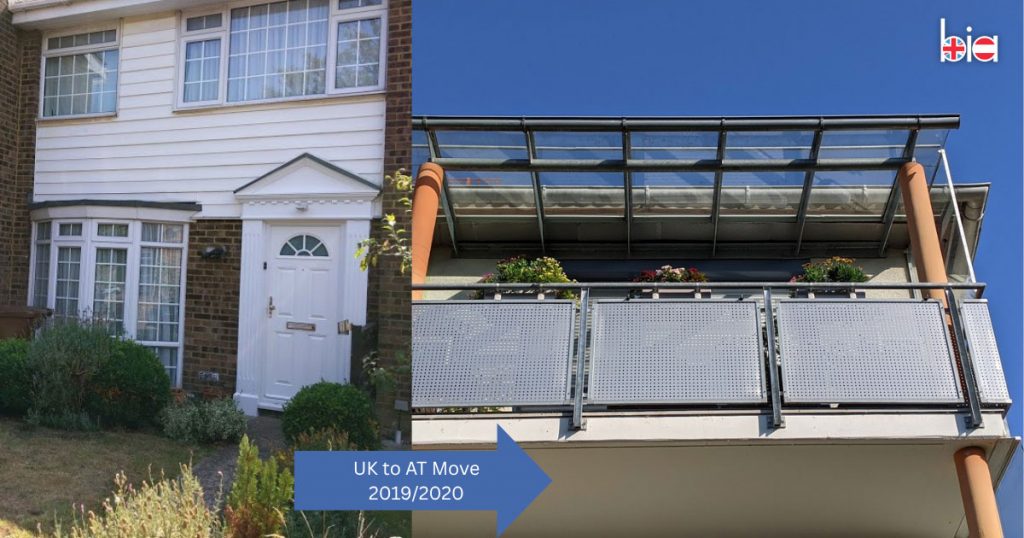
In around a year I needed to sell & clear two houses (one in Kent and one in Wales) and ship everything to Austria in a very short time during Covid.
I did and still do feel like a Brexit refugee having to leave my home country to preserve at least some of my EU rights. My EU rights are now confined to Austria and Ireland (CTACommon Travel Area The Common Travel Area is an open borders area covering the United Kingdom, Ireland, Isle of Man and the Channel Islands..) but they are still not the same as they were.
Withdrawal Agreement beneficiaries, were meant to get “similar” rights to those that we had enjoyed before the Brexit vote in our Host State. In some case, this is true, but in the case of Equal Treatment it is not! Withdrawal Agreement rights remain a challenge!
It is clear that job opportunities for someone with my age, skillset and limited German skills are better in the UK. I openly admit to struggling with the German language, much to my own annoyance.
Thankfully I have now acquired permanent residence in Austria and have a job working in the pharmaceutical industry in Vienna.
What are some of the highlights related to your BiAthe Facebook groups Britishinaustria.net draws upon its two Facebook groups as a source of questions to address in FAQs or to refer to the authorities or to request clarification from government ministries or HM British Embassy. These groups can be found at: British in Austria: https://www.facebook.com/groups/BritishAustria British in Europe ~ Austria: https://www.facebook.com/groups/BritishinAustria work?
I do hope that the work we do in British in Austria has helped others. We try to discretely work behind the scenes to help British Nationals in Austria (and sometimes the rest of the EU). We do also help other nationals too. Here are some of my own personal highlights:
- Getting NHS Overseas Services to document the Legislation Letter Process in 2020.
- Publishing the Health Insurance requirements for Austria for both British and other Third Country Nationals. This was a real pain for me in 2020.
- Getting email confirmation from the EU Commission in August 2021 that WAWithdrawal Agreement The Withdrawal Agreement sets out the terms of the UK’s withdrawal from the EU and provides for a deal on citizens’ rights. It sets out a transition period which lasts until 31 December 2020. During this time you can continue to live, work and study in the EU broadly as you did before 31 January 2020. If you are resident in Austria at the end of the transition period, you will be covered by the Withdrawal Agreement, and your rights will be protected for as long as you remain resident in Austria. Any rights that are not covered by the Withdrawal Agreement will be the subject of future negotiations. https://www.gov.uk/government/publications/new-withdrawal-agreement-and-political-declaration beneficiaries are exempt from ETIASEuropean Travel Information and Authorisation System (ETIAS) The European Commission's proposed European Travel Information and Authorisation System (ETIAS) is intended to strengthen security checks on those persons who travel visa-free to the EU, currently nationals from over 60 countries. The largely automated IT system will identify any security or irregular migratory risks posed by visa-exempt visitors travelling to the Schengen area, whilst at the same time facilitating crossing borders for the vast majority of travellers who do not pose such risks. Non-EU nationals who do not need a visa to travel to the Schengen area will have to apply for a travel authorisation through the ETIAS system prior to their trip. As of September 2025, it is planned to go live during the last quarter of 2026 (due to launch in Autumn 2026). The information has subsequently been published elsewhere on official EU Commission sites.
- Getting the British Embassy in Vienna on-board re. property rights for Withdrawal Agreement beneficiaries despite their initial reluctance. We now have seven out of nine provinces recognising the rights of Withdrawal Agreement beneficiaries; initially we had one (Tyrol).
- Helping a lady (Withdrawal Agreement beneficiary) successfully buy a property in Vorarlberg with her Austrian husband – we now regularly communicate online and I would love to meet her in person one day.
- Receiving a very open communication from the EDPBEuropean Data Protection Board The European Data Protection Board (EDPB) is a European Union independent body with juridical personality whose purpose is to ensure consistent application of the General Data Protection Regulation (GDPR) and to promote cooperation among the EU’s data protection authorities. that they also shared our concerns re. EESEntry/Exit System The Entry/Exit System (EES) is an automated EU digital border system that registers non-EU citizens each time they cross into or out of the Schengen area. It fully replaced traditional passport stamps with biometric tracking and digital records. in 2024 and 2025.
- Meeting a number of the other BiE country admins in person in Berlin and Prague as part of Project ICEProject ICE British in Europe, the non-profit organisation committed to the advocacy and support of UK citizens across the European Union, EEA and Switzerland, was awarded a significant grant by the EU Commission. It funded a project titled 'Inform, Connect, Empower: Capacity Building for Charter Agents of Change (ICE)' in 2024-2025, known as Project ICE.. It was nice to share experiences.
- Seeing correspondence in 2026 from Your Europe Advice recommending British in Austria to a UK national living in Austria.
- Helping a lady recently get Unterhaltsvorschuss (maintenance advance) following a complex case when the FCDOForeign Commonwealth and Development Office The Foreign Commonwealth and Development Office is the UK's "foreign ministry". As such British embassies report to the FCDO. However, passports are handled by the Home Office (hence why an Embassy cannot intervene in this regard). advised they could not help!
- Working with a great team in British in Austria, British in Europe, the wider BiE country groups and also the FCDO Consulate team in Vienna.
What could be better?
The Withdrawal Agreement was meant to preserve our rights in the host state so that they were similar to those we enjoyed before Brexit. For me there are some real disappointments:
- Equal Treatment regarding Property rights in Austria remain unfinished business. Considering this was first raised by me in February 2021 it’s a major personal disappointment. Seven out of nine of the provinces recognise WA rights, but Salzburg and Niederösterreich remain a problem. Niederösterreich in particular (where I live) remains a major disappointment as despite assurances given to TWO British Ambassadors, laws have not been updated and games continue to be played.
- Equal Treatment – there is no overriding Austrian National law which makes enforcement and support impossible in a number of areas. Publicity regarding our rights is also lacking.
- EU Commission monitoring and enforcement – There is limited EU commission monitoring of the WA which is primarily left to volunteers. There is also no enforcement as no cases have been brought to the CJEUCourt of Justice of the European Union The CJEU is the chief judicial authority of the EU and oversees the uniform application and interpretation of European Union law, in cooperation with the national judiciary of the EU member states.
- WA rights in the EU are only for the wealthy – currently WA rights can only be enforced if you have the funding and inclination to do so. Your Europe Advice is very good but their advice cannot be enforced as there is no publicly funded enforcement of EU law for the WA (you need money).
- The funding imbalance for Withdrawal Agreement beneficiaries in the UK compared to those of us in the EU is unfair.
- A lack of a streamlined FCDO “Contact Us” process for dealing with WA issues, this is despite consultancy being provided in 2021. This has also got worse as there is now no dedicated Citizens Rights team at the Embassy and only 2 people in the UK Cabinet Office. This is despite issues getting more complex and of a legal nature.
Anything Else
I would personally like to thank Mike Bailey for setting up and running the British in Austria website. I think the information we provide on the website has helped a lot of people and even the British Embassy in Vienna now signpost some of our articles.
My Austrian partner has been a great help; without her support and encouragement I would not be able to do all this volunteering work. Juggling the work/life balance is not always easy!
Useful Links
Last Modified